






Benedetto: The parable of the Prodigal Son
Benedetto has sent us a reflection on the well known parable of the Prodigal Son that is read during this time of Lent.
The parable of the prodigal son or of the merciful father is always used in Christian liturgy as a meditation on the meaning of pardon and reconciliation. In this time of penitence and of conversion, while we approach the Pascal sacrifice of the Lord, it offers us once again the occasion to reflect on our human condition, sinners that we are, and on the unconditional love of the Father who welcomes us always despite our infidelity.
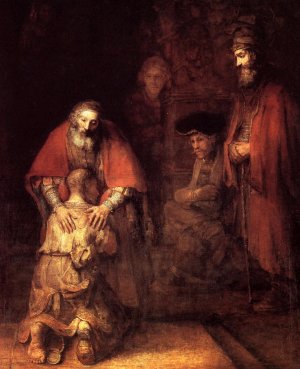
From the Lucan parable we learn that the younger son of a well to do father who is still living, decides to claim his part of the heritage in order to be autonomous and to be able to spend his life according to his own projects. Such a request would undoubtedly provoke the anger of any earthly father, considered dead before his time. This is not what happens in the narrative of Jesus. In fact, the father in the parable (surmounting the intimate pain that we can imagine results from such a request, it being both human and reasonable) gives in to the demand and distributes his wealth to his two sons, thus permitting the younger to take his distance from him.
Before we continue the narrative, let us stop and consider this attitude and ask ourselves if the same thing has not happened to us too. Through the parable, Jesus seeks to explain to us the dynamic of sin and of the mercy of God. Each time that we adhere to temptation, that we choose to sin, it is as if we are asking the Lord to leave us alone so that we can go off on our own path. It is as if we want to shake off the covenant with him and go off on an autonomous way according to which we rather than his Law are the unique criterion of choice. We too are permitted to go off by the father. He does not keep us prisoners, he does not hold us fast in his grasp. This is because the foundation of Law and Love is both free and freeing.
The young man, lacking in experience, is finally free of paternal authority and begins to put into practice his own criteria. Perhaps because of an excess of enthusiasm, he lets go and lives life with a hungry greed. The narrative does tell us about the quality of his life: unbridled excess, wine and sex with no limits, all the while the money holds out. However, the day arrives when he finds himself empty handed, without have built anything for the future and for his survival. At this time, the heavens remain sealed and the earth does not give its fruit. It is the time of famine.
We too know well this sensation. It is the isolation that is due to sin, the sense of bitterness, the consequence of our distancing ourselves from God (because it is always possible to go far away from him) and from others. The world now has nothing to offer us; the earth, a flowering garden, is transformed into a wilderness and the horizons of beauty vanish along with all joy and blessing. The moment of the turning point has arrived for the son. He finds a job, not very dignified and indeed humiliating, however it is a job. He himself does not know that it will be by means of this job that he will find the key to his return. He ends up serving as a swineherd, the animal that is impure par excellence in the Jewish world. However, this choice is not simply coincidental. Jesus knew what he was talking about. The young man ends up looking after pigs because of his suffering from hunger. He is desperate, without any remedy for his situation. This is the ultimate recourse that takes from him the last glimmer of dignity that is conferred by religious purity. He is a man in touch with the depths; in fact within himself he is dead and nothing has value anymore. Nonetheless, the tender hand of God and his providence do not accept the idea that he is totally lost. Again, it seems to me important to stress the symbolic figure of the pigs. In Hebrew, the word pig is "hazir", a sound that resonates as an insult as we can imagine might be the case when we speak of a filthy animal that one must take care not to come in contact with. However, if we take note we see that the word "hazir" (pig) is derived from the root in Hebrew h.z.r. which forms the word "hazar", meaning "return. Indeed, while he worked with the pigs, the son who was lost had the intuition that he must get up and get back on track and return home. With this, we understand that even in the most degrading of situations in which a person can find himself, the seeds of resurrection and ascension are present. The Lord, in his wisdom, leaves us signs that can bring us back to ourselves so that we can find our way again. We know from Paul that everything leads to the good. If we know how to look attentively and intelligently at everything around us, we will be able to discern the traces of a plan of salvation written there for us. For God it is never too late and we are always invited to return home.
We know the end of the story. The penitent son returns and is welcomed with joyful exultation. He is vested again with his lost dignity and is celebrated as one who has returned from the dead. This is the feast of reconciliation, a banquet to which each one is invited.
During these last few days that still separate us from Easter, we can still live this opportunity, our conversion is still possible. Yes, it is as if Lent has just begun. Let us be reconciled with God!
 Message of Epiphany: The Light Will Conquer the Darkness
 Fr. Benedetto: With Jesus in the wilderness during Lent
 Fr. Benny towards Lent
 Psalm for Lent
 Reflecting on Purim and on Lent
 Rosh HaShana – the Feast of God the Father