





Ziv – Parashat Miketz
The name of our parasha this week, “Miketz”, designates an end - or more precisely, following the Jewish tradition, the end of a dark period in order to enter into the light. The tradition here makes reference to the words of Job: “Men put an end to darkness, and search out to the farthest bound, the ore in gloom and deep darkness” (Job 28:3). It is therefore very appropriate that this parasha coincides with the Hannukah holiday every year. This word, “Ketz” is also related to the end of sleep, to waking up - especially after a dream. This is indeed the context of the parasha, and also of the haftara this week, since we find in them the dream(s) of Pharaoh, the dream of Solomon and underlying it all, the dreams of Joseph - and those of all of Israel.
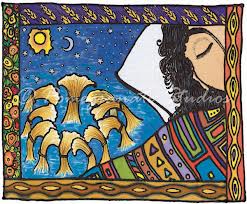
When Joseph dreamt his dreams, in the previous parasha (“VaYeshev”), he dreamt two dreams that are but one. In the first, he told his brothers: “Behold, we were binding sheaves in the field, and lo, my sheaf arose and stood upright; and behold, your sheaves gathered round it, and bowed down to my sheaf” (Gn 37:7). The second dream repeats this very same idea: “Behold, I have dreamed another dream; and behold, the sun, the moon, and eleven stars were bowing down to me” (Gn 37:9). There is, however, one very important detail that differentiates these two dreams: in the first, Joseph works with his brothers - he collaborates with them, even if he presents himself eventually as the greatest of them all. In the second, there is no more collaboration - it is the entire solar system that bows down to him.
Neither Joseph’s brothers who ask: “Are you indeed to reign over us? Or are you indeed to have dominion over us?” (Gn 37:8), nor Jacob, his father, who wonders: “What is this dream that you have dreamed? Shall I and your mother and your brothers indeed come to bow ourselves to the ground before you?” (Gn 37:10) understood his dream. It is also highly probable that Joseph himself did not comprehend it at the time. But in slavery and in prison, he had twelve years to ponder and interpret every detail of these dreams. In fact, he became an expert interpreter of dreams precisely because he did not cease to reinterpret and ponder these dreams that he had had at age 17.
However, now, in front of Pharaoh and his dreams - as he was telling Pharaoh: “The dream of Pharaoh is one” (Gn 41:25) - it is clear to Joseph, as well as to all the scribes and the sages of Egypt (according to the Midrash) that these dreams deal with famine. However, he alone also recognizes immediately the ears of wheat of which Pharaoh had dreamt. They are the same ones that he was binding into sheaves together with his brothers in his first dream. He understands that it has to be him who manages the supply of grain to Egypt and this is the reason why he has the confidence and the audacity to propose to Pharaoh: “Now therefore let Pharaoh select a man discreet and wise, and set him over the land of Egypt” (Gn 41:33).
It is at this moment that the darkness fades away and Joseph can see the fulfillment of his original mission, begun so long ago in the land of Canaan when an unknown man asked him “What are you seeking?” (Gn 37,15) to which Joseph replied “I am seeking my brothers, tell me, I pray you, where they are pasturing the flock”. Shabbat shalom.
 Message of Epiphany: The Light Will Conquer the Darkness
 Fr. Benedetto: With Jesus in the wilderness during Lent
 Fr. Benny towards Lent
 Psalm for Lent
 Reflecting on Purim and on Lent
 Rosh HaShana – the Feast of God the Father