Vicariato San Giacomo per i cattolici di lingua ebraica in Israele





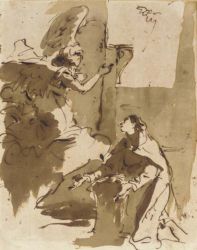
The words of the angel to Mary in Nazareth
Brother Yohanan Elihai, from the Jerusalem kehilla, sent us a short article to explain the different formulations of the prayer "Ave Maria" in Hebrew.
In general, the words of the angel who entered the room of Mary in Nazareth were translated as if he were saying to her: "Ave Maria, Hail Mary"… almost as if the angel were saying to her: "Good morning Mary, how are you?".
However, the Greek original does not say this.
The Greek word "khaire" means "rejoice, be glad".
If so, then where does the error in the translation come from? It would seem that it comes from Jerome, who translated the Old Testament and the New Testament into Latin, a translation known as the Vulgate. This translation was used by the Roman Catholic Church in Rome and throughout the world until the twentieth century. Why did Jerome use the word "Ave", a word used as a greeting for people who met one another? For a simple reason: in his time, Greek speaking people meeting one another, exchanged the greeting "khaire", meaning that a person meeting another would say: "Hey friend, be happy… or have a happy day".
What Jerome might not have known, or might have forgotten at that moment, was that Luke, fully soaked in the Old Testament, had in mind parallel verses in the writings of the prophets and not a simple greeting on the way.
There are two texts that are worth comparing with what Luke wrote:
Rejoice, daughter of Zion, shout aloud Israel!
However, the Greek original does not say this.
The Greek word "khaire" means "rejoice, be glad".
If so, then where does the error in the translation come from? It would seem that it comes from Jerome, who translated the Old Testament and the New Testament into Latin, a translation known as the Vulgate. This translation was used by the Roman Catholic Church in Rome and throughout the world until the twentieth century. Why did Jerome use the word "Ave", a word used as a greeting for people who met one another? For a simple reason: in his time, Greek speaking people meeting one another, exchanged the greeting "khaire", meaning that a person meeting another would say: "Hey friend, be happy… or have a happy day".
What Jerome might not have known, or might have forgotten at that moment, was that Luke, fully soaked in the Old Testament, had in mind parallel verses in the writings of the prophets and not a simple greeting on the way.
There are two texts that are worth comparing with what Luke wrote:
Rejoice, daughter of Zion, shout aloud Israel!
Be happy, exult with all your heart, 'Rejoice, you who enjoy God's favor!
... The Lord is within you, The Lord is with you (....)
Do not be afraid, O Sion do not be afraid;
(Zephaniah 3:14-15) you have won God's favor...
Exult greatly, daughter of Zion! (Luke 1:28,30)
Shout aloud,
daughter of Jerusalem!
(Zechariah 9:9)
This is what inspired Luke in expressing what the angel said to Mary. After all, there was no one there with a tape recorder in order to record what he said. Luke probably heard from Mary about the experience and formulated beautifully the content of the word of the Lord.
This same Luke, writes elsewhere the canticle of Mary (1:46-47, 52-53) and he uses ideas and expressions, similar to those found in the canticle of Hannah, mother of Samuel (1Samuel 2:1.4-5).
This was clarified last century by renowned experts, especially French exegetes, and since then the translation was changed in a variety of new translations into French and English, for example the Wesley translation (1990) and the latest edition of the Jerusalem Bible, where there is also a footnote that explains this issue. Unfortunately, most of the translations have not as yet adopted this important change. The translators have not yet heard of the articles of these exegetes. We can only hope that this will happen in the not too far off future. There is one interesting exception: the Russian version has ???????, it would seem because Cyril and Methodius, who evangelized the Slavic peoples, knew Greek and they translated "khaire" as should be, ???????, which means "rejoice, be glad". This is also the case in the Ukrainian translation.
Another comment, "peace be with you" does exist in the New Testament and is the translation of eivrh,nh u`mi/n ("eirene humin"). The intention of this expression is truly: peace be upon you. This is what Jesus meant when he used the expression in John 20:19 and elsewhere. In the words of the angel to Mary, this is not what is meant.
Do not be afraid, O Sion do not be afraid;
(Zephaniah 3:14-15) you have won God's favor...
Exult greatly, daughter of Zion! (Luke 1:28,30)
Shout aloud,
daughter of Jerusalem!
(Zechariah 9:9)
This is what inspired Luke in expressing what the angel said to Mary. After all, there was no one there with a tape recorder in order to record what he said. Luke probably heard from Mary about the experience and formulated beautifully the content of the word of the Lord.
This same Luke, writes elsewhere the canticle of Mary (1:46-47, 52-53) and he uses ideas and expressions, similar to those found in the canticle of Hannah, mother of Samuel (1Samuel 2:1.4-5).
This was clarified last century by renowned experts, especially French exegetes, and since then the translation was changed in a variety of new translations into French and English, for example the Wesley translation (1990) and the latest edition of the Jerusalem Bible, where there is also a footnote that explains this issue. Unfortunately, most of the translations have not as yet adopted this important change. The translators have not yet heard of the articles of these exegetes. We can only hope that this will happen in the not too far off future. There is one interesting exception: the Russian version has ???????, it would seem because Cyril and Methodius, who evangelized the Slavic peoples, knew Greek and they translated "khaire" as should be, ???????, which means "rejoice, be glad". This is also the case in the Ukrainian translation.
Another comment, "peace be with you" does exist in the New Testament and is the translation of eivrh,nh u`mi/n ("eirene humin"). The intention of this expression is truly: peace be upon you. This is what Jesus meant when he used the expression in John 20:19 and elsewhere. In the words of the angel to Mary, this is not what is meant.
The original article is in Hebrew 
 Message of Epiphany: The Light Will Conquer the Darkness
 Fr. Benedetto: With Jesus in the wilderness during Lent
 Fr. Benny towards Lent
 Psalm for Lent
 Reflecting on Purim and on Lent
 Rosh HaShana – the Feast of God the Father