



O Death, Where is thy Victory?
Matthew, from the Beer Sheba community, wrote for us a fascinating article on a famous phrase from Saint Paul to help us prepare for Easter.
In 1 Corinthians 15:55 we read these stirring words from the Apostle Paul: "O death, where is thy victory? O death, where is thy sting?" For the modern reader, it sounds like a simple personification of death, introduced for rhetorical purposes. But the preceding verse, in which he cites Isaiah 25, provides a clue to a mythological background to this taunt, and understanding this background can help us appreciate the majesty of the Easter season in a new light.
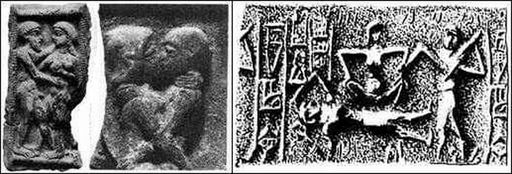
The Baal epic from Ugarit preserves a portion of the mythology prevalent in Canaan during the period prior to and contemporaneous with the kingdoms of Israel and Judah. This is a rip-roaring story, full of sex, violence and ... feasting. The gods fight a little, eat a bunch, and fight some more, all the while jockeying for the position of head-honcho of the Canaanite pantheon. The primary conflict in the narrative takes place between Baal Hadad, the god of storm and fertility, and his rival, Mot, i.e., Death.
Mot is a fearsome enemy. He possesses a gaping mouth, through which he swallows down anything around him. He challenges Baal to a fight for supremacy with an invitation to a banquet, a banquet in which Baal will be the main course. "One lip to Hell, one lip to Heaven, a tongue to the Stars. Baal will enter his innards, into his mouth he will descend like a dried olive, produce of the earth and fruit of the trees," (from "The Baal Cycle," translated by Mark S. Smith, in Ugaritic Narrative Poetry, Simon B. Parker, ed., p. 143). The two enemies meet, and Baal is indeed vanquished by Mot, and descends into the bowels of the underworld.
But this is not the end of the story. Somehow, Baal manages to rise up from the world of the dead and take vengeance upon Mot. However, there is no conclusive victory on either side. As the poem draws to a close, the reader realizes that the struggle between the forces of life and death is interminable. (Some interpreters have suggested that the seasonal cycle or, more likely, the periodical droughts that afflict the Levant are the inspiration for the poem).
In Isaiah 25, God treats His faithful to a rich banquet: "On this mountain the LORD of hosts will make for all peoples a feast of fat things, a feast of wine on the lees, of fat things full of marrow, of wine on the lees well refined" (verse 6). At this banquet, God turns the tables on big-mouthed Mot: "He will swallow up death for ever" (verse 8). (The word for death in Hebrew is a cognate to Mot, mavet). In 1 Corinthians 15:54, when the Apostle Paul quotes this verse, he interprets the word netzach with a different meaning: "Death is swallowed up in victory."
Isaiah 25:8 was an important promise to Israel. The day is coming, says the Lord, when the cycle of life and death that all of creation is trapped in will be broken, because Mavet will be swallowed up, not temporarily, but "for ever" in "victory". The Lord will accomplish what the gods of Israel's neighbors cannot.
This promise began to be fulfilled with the resurrection of our Lord Jesus on Easter Sunday. Like Baal, He too descended into the belly of the earth, but unlike him, Jesus utterly defeated Mot, and can never be threatened by him again. The cycle of life and death has finally been broken. Since that day, the life flowing from our Lord to us continues to increase. Someday soon, as the Apostle Paul wrote, "the trumpet will sound, and the dead will be raised imperishable, and we shall be changed" (1 Corinthians 15:51). On that day, death will finally not only be defeated, but destroyed, swallowed up. The victory that our Lord gained over death will fully be our own. "For as in Adam all die, so also in Christ shall all be made alive" (1 Corinthians 15:22).
 Message of Epiphany: The Light Will Conquer the Darkness
 Fr. Benedetto: With Jesus in the wilderness during Lent
 Fr. Benny towards Lent
 Psalm for Lent
 Reflecting on Purim and on Lent
 Rosh HaShana – the Feast of God the Father